Where placements slip
Recruitment closes the deal; operations and finance inherit the paperwork. The client signs the order weeks late, the contractor’s bank account for the VAT whitelist arrives after the first payment is due, a contract ends while the client still wants the person.
What Clamra checks for every placement
- Onboarding for every new person.
Each placement moves through invitation, company checks, VAT status, the whitelist, contract and NDA to ready to start, with an owner and a date for every step.
- Both signatures, and how late they came.
Unsigned orders and late client signatures become tasks for the account manager, one click for many.
- The bank account on Poland’s VAT whitelist.
A live check against the Ministry of Finance register, with the request ID kept as evidence, before the first payment.
- Renewals before they lapse.
Contracts and orders that run out are listed ahead of time, and the annex is drafted from the data: the term follows the client’s order and the notice period comes from the client’s agreement.
- Hours reported, accepted and invoiced.
Hours come from the client’s timesheet export. Accepted hours that were never invoiced, and contractor invoices that differ from the agreement, are flagged with the amount.
- The margin, against the norm.
Margin by client, role and seniority over time. Change a client rate and Clamra shows the new margin and asks whether the change is intended.
The screens your team would use
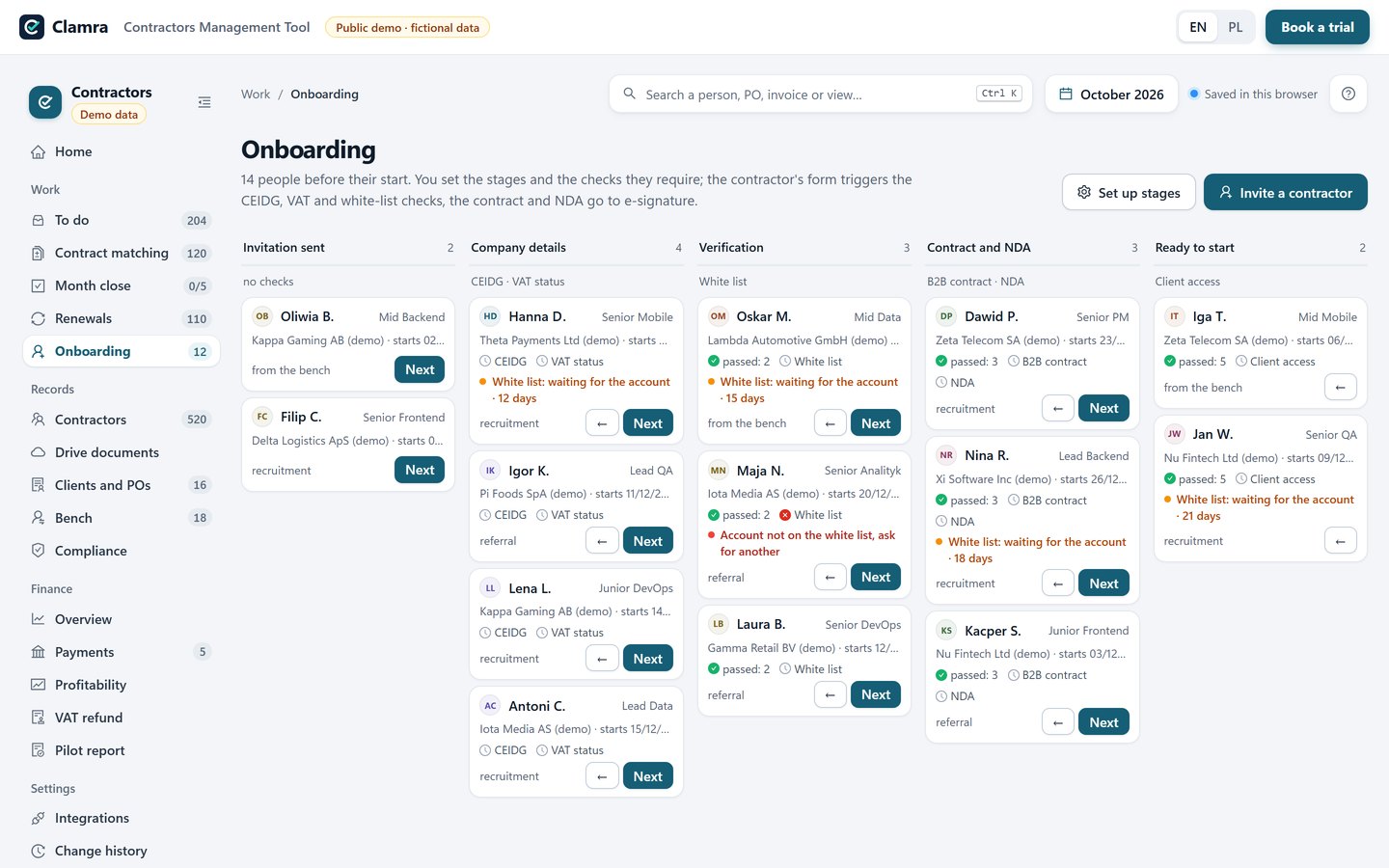
Onboarding. Company checks, the VAT whitelist, contract and NDA for every new person. 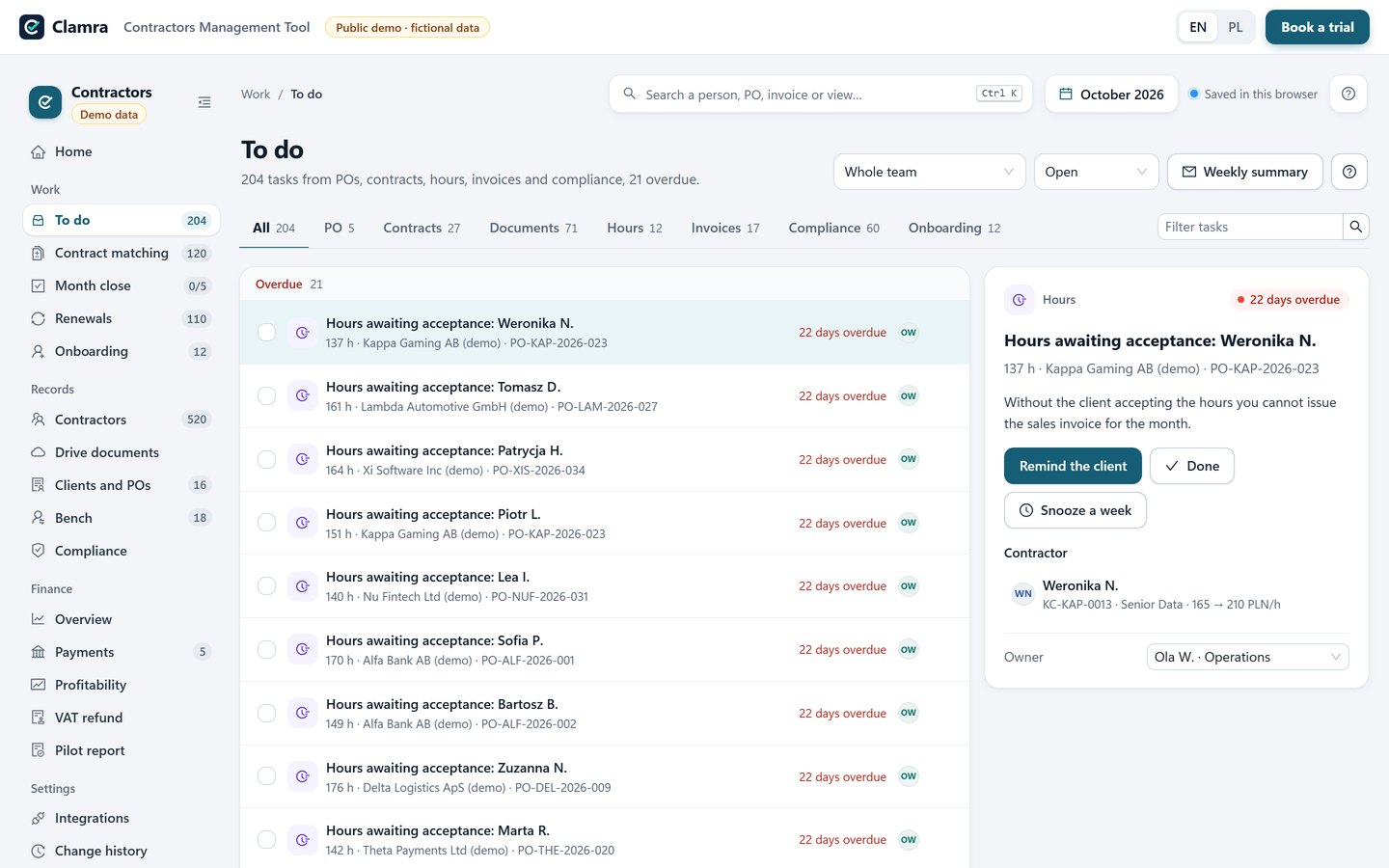
To do. Every task that needs a person today, worked out from the documents.
The Contractors module was built with an IT staffing firm. Agencies that place contractors run on the same three-party paperwork: one agency, one contractor or freelancer, one client. Demos and screens use fictional IT staffing data; a trial on your own documents is agreed with your team first.
Clamra covers contract placements. Fees for permanent hires are not part of the module.
Questions
Where do our documents go, and when can we upload real ones?
Walkthroughs run on fictional data. Real contracts, orders, timesheets and invoices are uploaded only after your agency accepts processing terms under GDPR Art. 28 (a data processing agreement). In the pilot the documents are read on Clamra’s own server, and a full export of your data is available at any time.
Do you send our documents to an external AI?
No. Rules and local OCR read the documents on Clamra’s server; no external AI model receives them. AI does not write fields: a value that cannot be traced to a document stays empty and visible, and a person confirms, corrects or rejects every match.
Does Clamra email clients or send contracts on its own?
No. Emails and purchase-order requests are drafts for your account manager, never sent to the client by Clamra. Annexes are drafts a person approves, and the e-signature step through Autenti is simulated in the demo.
We already use Bullhorn, Comarch Optima or Excel. Do we replace them?
No. Clamra is not an ATS, ERP or accounting system and does not post entries or settle VAT. It works next to the tools you have: hours come from the client’s timesheet export or a spreadsheet, and every check can be exported as CSV. Direct connectors for accounting systems are next, not live yet.
How is Clamra priced, and what does a trial look like?
Pricing is per active contractor per month. A trial is scoped before it starts: a few contractors and one client, with the scope, success criteria and access agreed with your team, and a full export of the data at the end.