Where does the margin go?
In a staffing firm the contractor’s agreement sits in Google Drive, the client’s order arrives by email or through the client’s portal, hours are approved in the client’s own timesheet tool and invoices live in the accounting system. Each document is correct on its own. Nobody checks that they agree, so rates get overwritten, contracts lapse while the order runs on, accepted hours go unbilled and margin leaks without anyone noticing.
Checking all of it properly takes a controller, a contract specialist and a VAT adviser. For hundreds of contractors, nobody can staff that. Clamra puts their checks next to the coordinator who keeps the spreadsheet today.
What Clamra checks for every contractor
- The same person, period and rate on both sides.
The contractor’s agreement and the client’s order are compared line by line. A gap says exactly why: the order says 255 PLN/h, the system says 245; the agreement ended on 14 October, the order runs to April.
- Both signatures, and how late they came.
Unsigned orders and late client signatures become tasks for the client’s account manager, one click for many.
- Hours reported, accepted and invoiced.
Hours come from the client’s timesheet export. Accepted hours that were never invoiced, and contractor invoices that differ from the agreement, are flagged with the amount.
- The margin, against the norm.
Margin per contractor, per client, role and seniority over time. Change a client rate and Clamra shows the new margin and asks whether the change is intended.
- The bank account on Poland’s VAT whitelist.
A live check against the Ministry of Finance register, with the request ID kept as evidence, before the first payment.
From a Drive folder to a fixed gap
Most firms already keep one folder per contractor, named after the person. Clamra reads that folder as it is — PDFs and scanned orders, read on Clamra’s own server with OCR — matches each folder to the right contractor and files the documents on the record. When something needs to change, the next step is drafted from the data: an annex that follows the client’s order and notice period, a request for a new purchase order, or a reminder to the account manager. The coordinator acts; the expert only reviews the exceptions.
Live in our private pilot: contract matching, reconciliation of hours, invoices and margin, reading Drive folders and scans, the VAT whitelist check and a full data export. Next: a direct Google Drive connection (today a folder or ZIP from Drive), e-signature through Autenti (simulated in the demo) and connectors for accounting systems. Demos run on fictional data.
The screens your team would use
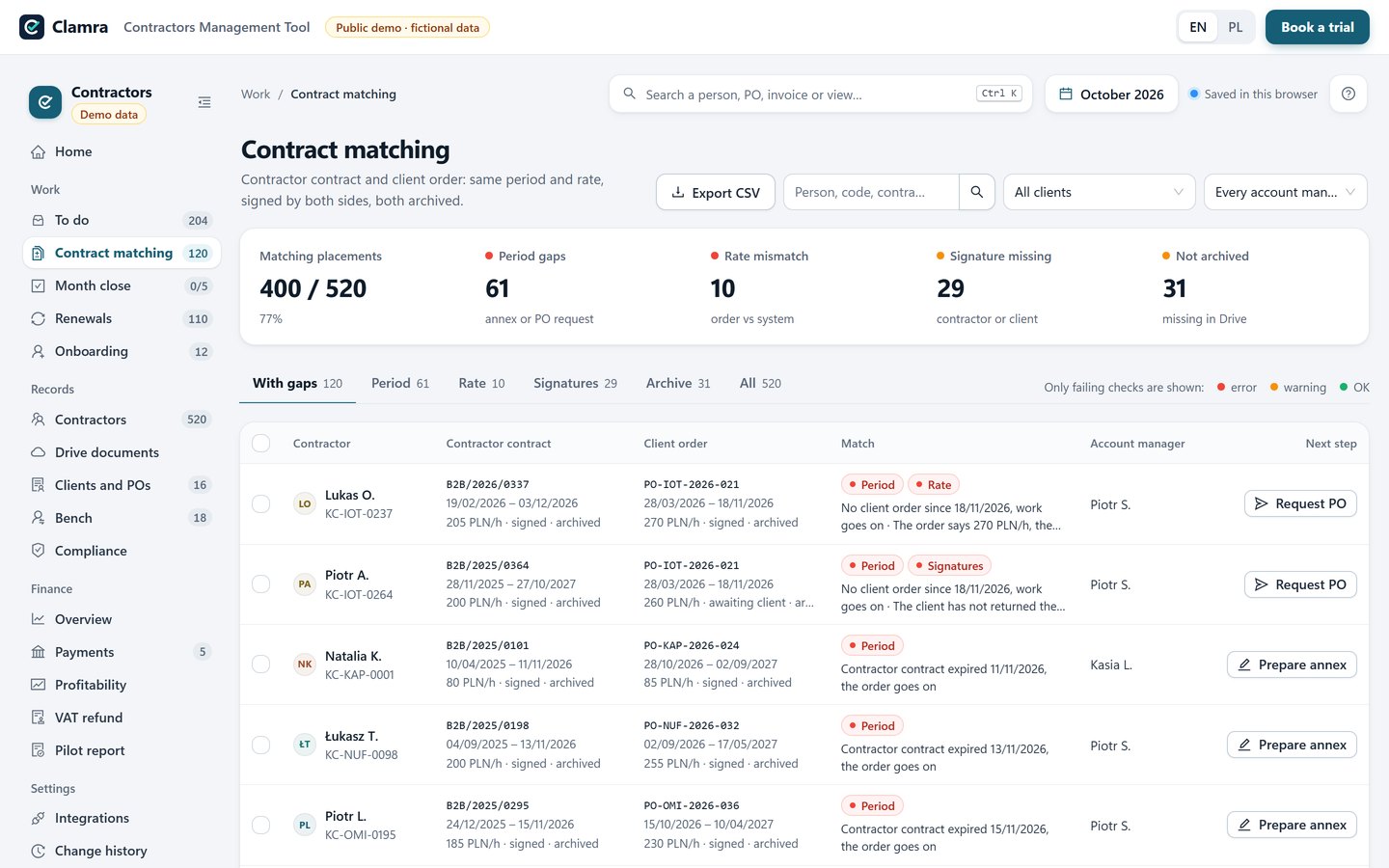
Contract matching. Both sides of every placement, each gap with its reason. 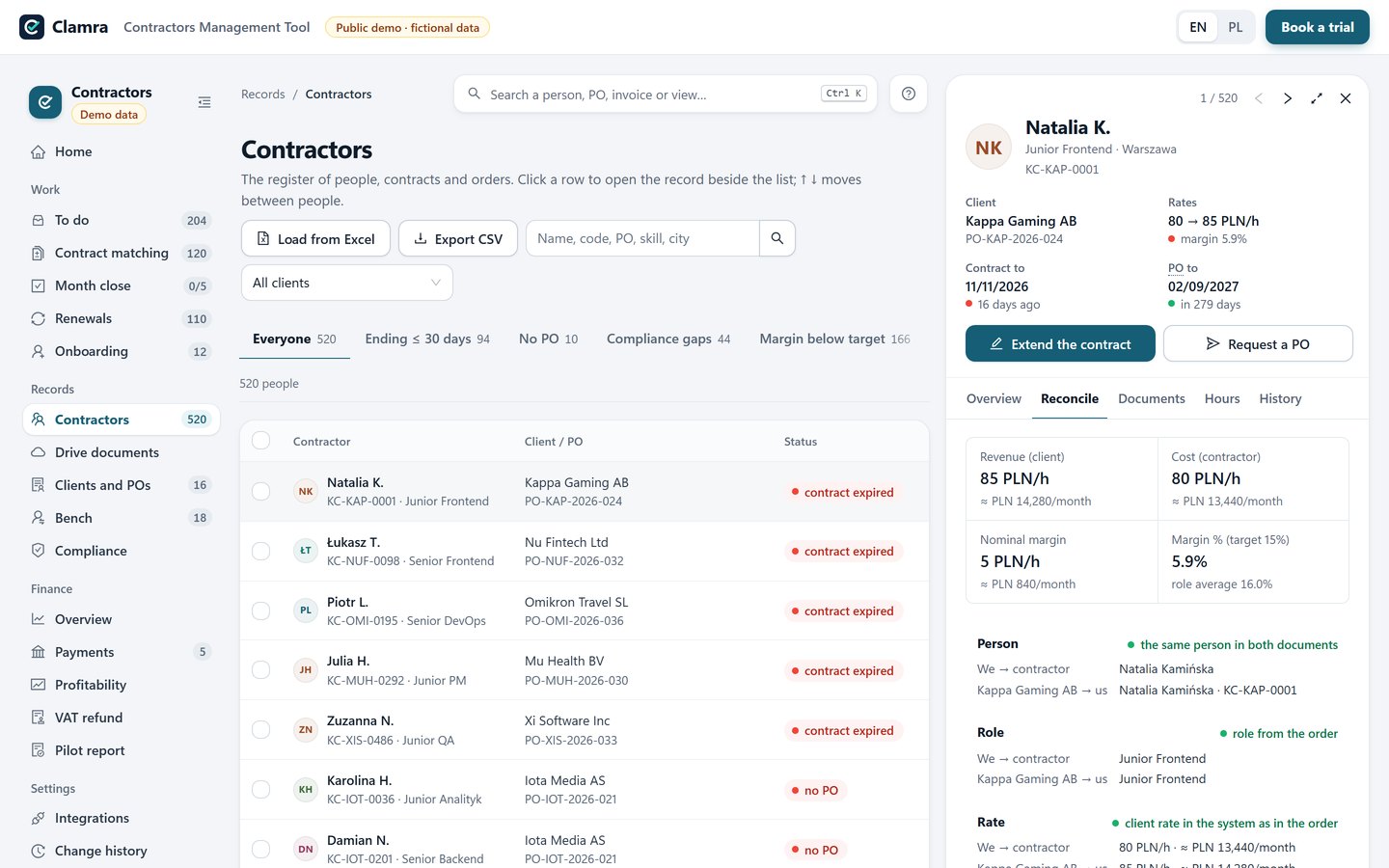
One record, both sides. Rate, term, signatures, hours, invoices and margin, with a what-if on the rate.
One rule behind every check
Numbers are never guessed: a value Clamra cannot trace to a source document stays empty and visible, rules and local OCR read the documents, and a person decides on every gap. Every finding links to the contract, order, timesheet or invoice behind it.
Request a walkthrough with fictional data.
Questions
Where do our documents go, and when can we upload real ones?
Walkthroughs run on fictional data. Real contracts, orders, timesheets and invoices are uploaded only after your company accepts processing terms under GDPR Art. 28 (a data processing agreement). In the pilot the documents are read on Clamra’s own server, and a full export of your data is available at any time.
Do you send our documents to an external AI?
No. Rules and local OCR read the documents on Clamra’s server; no external AI model receives them. AI does not write fields: a value that cannot be traced to a document stays empty and visible, and a person confirms, corrects or rejects every match.
Does Clamra email clients or send contracts on its own?
No. Emails and purchase-order requests are drafts for your account manager, never sent to the client by Clamra. Annexes are drafts a person approves, and the e-signature step through Autenti is simulated in the demo.
We already use Bullhorn, Comarch Optima or Excel. Do we replace them?
No. Clamra is not an ATS, ERP or accounting system and does not post entries or settle VAT. It works next to the tools you have: hours come from the client’s timesheet export or a spreadsheet, and every check can be exported as CSV. Direct connectors for accounting systems are next, not live yet.
How is Clamra priced, and what does a trial look like?
Pricing is per active contractor per month. A trial is scoped before it starts: a few contractors and one client, with the scope, success criteria and access agreed with your team, and a full export of the data at the end.